The first close after an ERP cutover is where intercompany breaks compound into restatements if the repair is manual. Siemens cut intercompany line items requiring manual analysis from more than 15,000 to fewer than 200 once that work was automated against a continuous shadow of the source system.
Four failure modes only appear after cutover and don't surface in a steady-state multi-currency close: orphaned trading-partner codes from an incomplete mapping, FX rates that read differently in source and target, legacy journals that reopen when the cutoff is soft, and elimination rules that never got ported.
Each class needs a different probe and a different clearing move. An AP agent and a Controller agent, both reading from a shadow ledger and neither writing to the live one, is the pattern that keeps the first close provable.
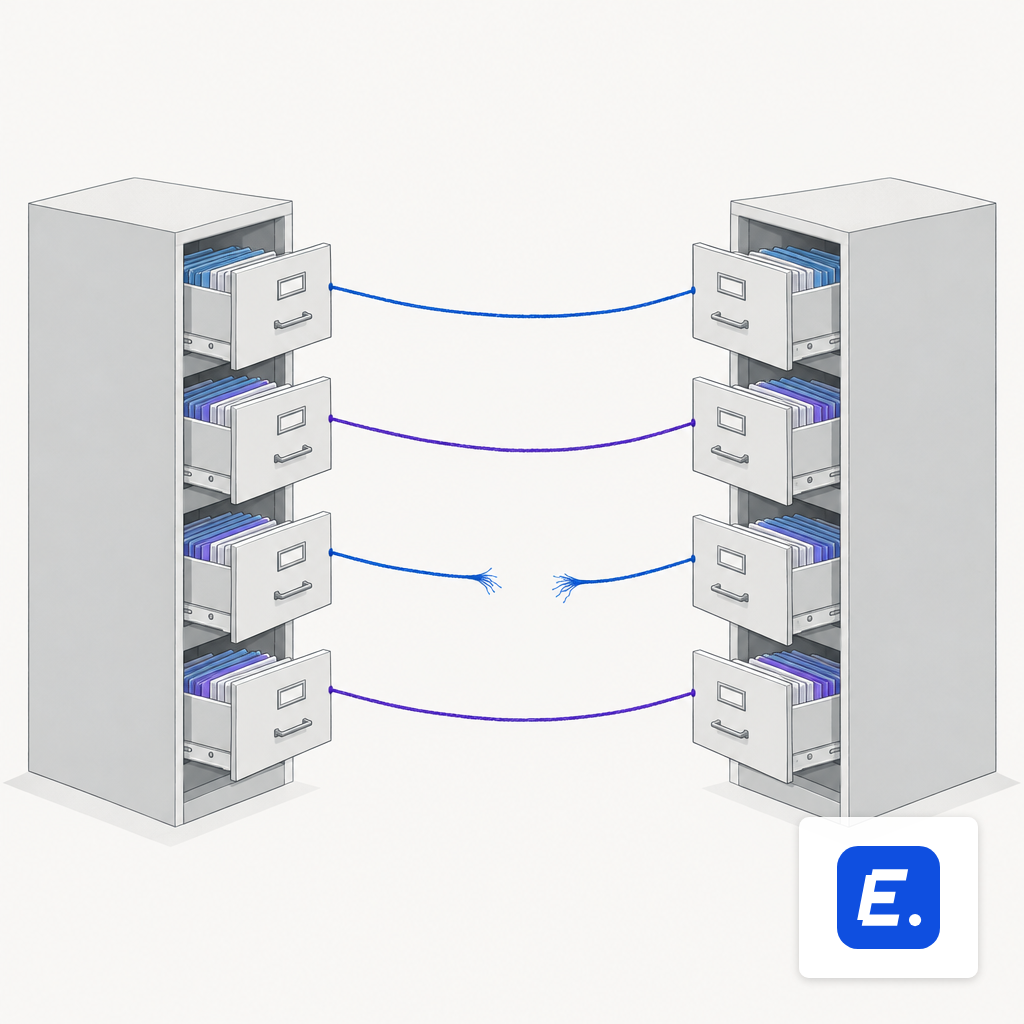
Orphaned Trading-Partner Codes Break First
A trading-partner code is the handle that an intercompany receivable on one entity's books uses to find its matching payable on another entity's books. In the source ERP, these codes typically lived in a dropdown tied to the vendor master. During cutover, the mapping often loads only vendors that had activity in the migration window, so any dormant intercompany relationship arrives on day one without a counterparty. The symptom is specific: the AR side posts cleanly, the AP side posts cleanly, and nothing matches during the first elimination run.
The AP agent compares the post-cutover trading-partner table against the full historical intercompany pair list exported from the source system, flags every receivable whose counterparty code either does not exist or points to the wrong entity, and queues a mapping correction. The Controller agent approves the mapping against the original legal-entity register. Neither agent writes to the ledger; both propose journal lines that a named human posts.
BlackLine's 2023 survey of 263 intercompany stakeholders found 99% report process challenges and 97% have resolved multi-million-dollar material variances. Orphaned partner codes are the single most common driver of those variances in the first post-cutover close because they manifest as pairs that look fine on both sides individually.
FX Rate-Source Drift Hides in the Decimals
The source ERP may have used a daily rate pulled from one provider. The target may be using month-end rates from another, or spot rates with different rounding rules. For in-month intercompany invoices that straddle cutover, the receivable gets booked at one rate and the payable at another. A 0.0005 difference on a $400,000 intercompany invoice is $200, replicated across every pair that posted in the window.
The Controller agent checks three things against the shadow ledger: which rate was used on the source side, which rate the target applied on the matching side, and whether the delta is attributable to rate drift rather than timing. When all three answer yes, the agent proposes an FX revaluation line coded to a migration-period suspense account that the chart of accounts should carry specifically for cutover cleanup. A CoA migration done correctly leaves this account in place from day one.
Reopened Legacy Journals Bend the Cutoff
Cutover rarely closes the source system on a single day. Most teams run a parallel period where source-side adjusting entries continue to post to catch up prior-period activity. Those late postings reopen journals the target ERP thought were final, creating intercompany pairs whose amount changed between runs of the elimination. A $12,000 intercompany allocation on June 28 that becomes $12,480 on July 2 after a source-side reclass is the classic case, and the delta is what later becomes an audit finding.
The AP agent runs a daily delta against the source extract for every intercompany transaction posted in the parallel period, flags any change in amount, memo, or dimensional coding, and proposes a reversal plus repost in the target. The Controller agent runs the second check: the reversal timing must not land in a prior closed period on the target side. A migration delivered with reconciliation proof gives both agents the shadow ledger they need to run those checks continuously rather than only at close.
Elimination Rules Rarely Travel With the Ledger
Elimination rules often live in a consolidation tool bolted on top of the source ERP, not in the ERP itself. During cutover, implementers focus on the ledger, the AR/AP sub-ledgers, and the chart of accounts. The elimination rule set, encoded as a stack of conditional expressions over entity, account, and department, usually gets rebuilt from scratch in the target. A rule missing a single clause (for example, failing to eliminate interest on intercompany notes above a threshold) leaves a residual in consolidation that nobody catches until auditors do.
The Controller agent runs a dry elimination against both the source system's rule set (pulled into the shadow ledger) and the target's new rules, then diffs the two totals account by account. Any account where the two disagree points to a rule that wasn't ported, classified and routed for review. Deloitte's leading-practices guidance treats this kind of rule inventory as a precondition for consolidation, not a cleanup task.
- 1Disparate systems across legal entities
- 2Intercompany settlement
- 3Complex intercompany agreements
- 4Transfer-pricing compliance
- 5Foreign exchange exposure
The AP and Controller Agents Work Off a Shadow Ledger
The shadow ledger is the architectural piece that makes the repair pattern mechanical. It is a read-only replica of the source system's intercompany postings for a defined parallel window, usually 30 to 60 days after cutover, against which the target ledger is continuously diffed. The AP agent operates line by line, proposing corrections to specific intercompany pairs. The Controller agent operates rule by rule, proposing changes to elimination logic or FX revaluation parameters. Neither writes to the deterministic ledger directly, which is the control that makes this safe during the window when everything is already fragile.
Each proposed entry is routed to a human approver with the source lines, the target lines, the delta, and a short classification tag. Velosio's 2026 ERP study of 151 mid-market decision-makers found 68% of finance teams lose 11 or more hours per week to manual reconciliation; the point of the agent pair is to absorb that time without changing where authorship of the ledger sits.
Migration reconciliation evidence has to survive audit. Reconciliation evidence that survives an audit means every agent-proposed adjustment carries both source and target line references, the rule or mapping it was generated from, and the approver identity. That record is what turns a cutover cleanup from a story into a provable one when the external auditor asks why consolidated eliminations moved by $147,000 between the May and June runs.
What a Clean First Post-Cutover Close Looks Like
Back to the Siemens figure. The drop from 15,000 line items needing manual analysis to fewer than 200 was not achieved during a steady-state close. It required a repair pattern that ran continuously against a shadow of the source system until the cutover window closed, then handed the target ledger over as the single source of truth. For a mid-market multi-entity close the same logic applies at smaller scale. The target is not zero breaks in the first close (that is not realistic) but zero unknown breaks, where every variance has a class, a proposed fix, a named approver, and a timestamp. The erp.io platform is built around this pattern because the first post-migration close is the one most likely to produce a restatement if the agents and the shadow ledger are not in place before cutover.