A Controller agent that genuinely runs a month-end close does four narrow jobs: tie subledgers, propose accruals, triage exceptions, and gate journal posting. Everything else is a demo flourish, and the test is whether the deterministic ledger ever sees a write the agent authored directly.
Closing faster is a reconciliation problem before it is an AI problem. The procedural question is what the agent does between the trial balance drop and the final post, and where a human still holds the pen.
The Handoff at Trial Balance
The cycle begins when the subledgers close and the trial balance lands in the Controller agent's working set. At that point the agent reads balances, open items and prior-period comparatives, then orders the close tasks against a calendar it already knows: bank reconciliations first, because they gate everything downstream; subledger ties next; accruals after accrued expenses have been identified from AP and vendor-side signals; intercompany and FX; then the trial-balance review.
The control at this point is read-only ledger access. The agent extracts, classifies and proposes, but a separate posting service holds the only credentials that can write journals. That separation is the architectural claim behind an AI in ERP deployment a controller can defend to auditors. If the agent can both read and write, what the vendor is selling is a scripted automation with a chatbot in front of it, not an agent operating inside an auditable control boundary. For deeper context on where that boundary gets drawn, our note on where AI fails inside an ERP covers the write-path argument in full.
Reconciliation, Subledger by Subledger
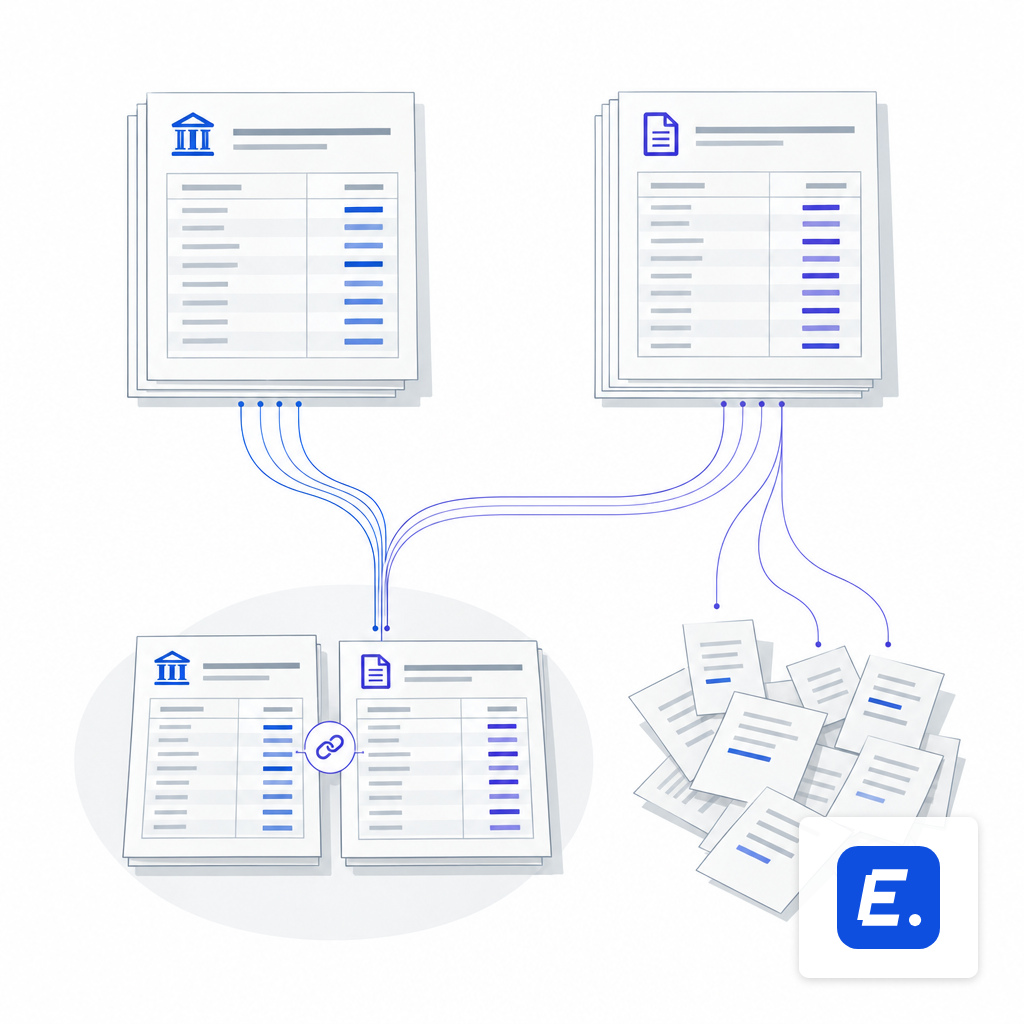
Automated reconciliation is where close automation either earns the quarter or wastes it. The agent pulls a bank feed, matches each transaction against open ledger entries on amount, date tolerance, counterparty and memo, and clusters the residuals. A clean match is written to a reconciliation worksheet with a confidence score. A partial match carries both candidates and a reason. An unmatched item is pushed to the exception queue with its own severity.
The same loop runs for AR against the cash application file, AP against vendor statements and bank debits, intercompany against the counterparty entity, and inventory against the warehouse management feed. For each subledger the agent reports a tie figure, an unexplained variance figure, and a list of broken joins with proposed fixes. Resolve or reclassify is a human call, logged as an exception decision.
| Measure | Manual reconciliation | Automated reconciliation |
|---|---|---|
| Days per close cycle | ~8 days | ~3 days |
| Annual person-hours, 1,000-FTE org | ~100,000 | Reduced |
| Hours lost per staffer to fragmented reports/yr | ~50 | Reduced |
Drafting Accruals and Recurring Journals
Journal entry automation is the second time sink the agent absorbs. It reads received-not-invoiced reports from AP, open POs past expected delivery, timecards for services not yet billed, lease schedules under ASC 842 and revenue schedules under ASC 606, and drafts journals with debit, credit, cost centre, memo and supporting link. Each draft carries the rule it used, the source document it read and the amount history of the same accrual across prior periods.
Recurring journals (depreciation, amortisation, standing prepaids, straight-line rent) run as templates the agent instantiates for the period. Each instance is compared against the prior period's instance, and variance outside tolerance is flagged for review before it is queued for posting. This is where close orchestration earns its name. The agent is not drafting one journal at a time, it is drafting the whole set in parallel and sorting them for review by variance, risk and materiality. For teams running this across several legal entities, the companion piece on designing a multi-entity close covers the sequencing before the first journal is drafted.
Exception Triage, Where Judgment Lands
Every close has a residual: the unmatched line, the duplicate payable, the vendor who sent an invoice for a PO that was cancelled. Exception handling in finance is the test of whether the agent is useful at all, because this is where cost accumulates and where auditors spend their time. The agent groups exceptions by type and probable cause, proposes a resolution with the evidence it already pulled, and routes each to the responsible owner with a deadline tied to the close calendar.
The economics are blunt. A Gartner survey of 204 finance leaders in March 2026 found that 45% of CFOs steer AI toward productivity while only 20% steer it toward decision quality, yet 31% of the decision-quality group reported significant value against 17% for productivity. Exception triage is a decision-quality workload, which is where the reported return lives. Deloitte's work with controllers lands in the same place, noting that the earliest wins from AI inside the close show up in pattern recognition over the exception queue, not in faster keystrokes elsewhere.
The Post Gate and the Audit Trail
Nothing the Controller agent proposes reaches the ledger without a gate. Each drafted journal carries a materiality classification, the controls that were applied, the preparer (the agent) and the required reviewer. The posting service checks that approvals match the delegation matrix, that the period is open, that the cost centre is active, and that the sum of the journal's lines is zero before it writes. A reject returns to the agent with the reason, and the agent either corrects or escalates.
The audit trail is the point of the whole architecture. Every read, every proposal, every rule invocation and every human decision is written to an immutable log tied to the journal ID. McKinsey's work on the AI-powered finance function frames this as the condition for AI to sit inside the controls rather than beside them: the output is not the journal, it is the journal plus its lineage. That is what makes a close defensible when SOX walks in. The erp.io platform page documents the Controller agent's permissions and the post gate it has to pass through.
What to Watch From Here
The metric that tells a finance leader whether a Controller agent is real is the ratio of agent-drafted journals that post without a human edit, measured monthly and segmented by journal type. A ratio climbing through 70% on recurring journals and 50% on accruals, with exception-queue aging flat or shrinking, is a close getting faster for the right reason. A ratio that starts high and drifts as transaction volumes grow, or climbs while variance explanations get thinner, is theatre. Watch that number, not the demo.