A consolidated balance sheet ties out only when intercompany eliminations match at the transaction, FX revaluation runs on the right rate, and the cumulative translation adjustment proves itself before sign-off. The cross-border close fails at one of those three joints, every month.
ASC 830 and the elimination rules in ASC 810 are not the controversy. Producing their proof for twenty entities in eight currencies, in days rather than weeks, is. The mechanism matters because roughly 41% of S&P 500 revenue is earned outside the United States, so the translation column of the group trial balance is not a footnote.
Where Multi-Currency Consolidations Break
Three joints fail repeatedly. The intercompany balance between Parent-US and Sub-DE is booked at different rates on the two ledgers, so elimination lines leave a stub that gets plugged to equity. Period-end revaluation runs on a closing rate pulled before the entity finished its sub-ledger, so retranslated monetary items disagree with the trial balance by the time the group rolls up. And CTA, the plug that absorbs the difference between translating assets at the closing rate and equity at the historical rate, is calculated but never traced back to the entities that produced it.
None of these errors are exotic. They are the dominant feeders into the kind of debt and equity classification issue that appeared in 27% of 2025 restatements. The root cause is almost always the same: the three joints are closed by humans working off spreadsheets after the subsidiaries have shut the books. The design question is who holds the evidence at each step, not who computes the number.
Intercompany Elimination Is a Matching Problem
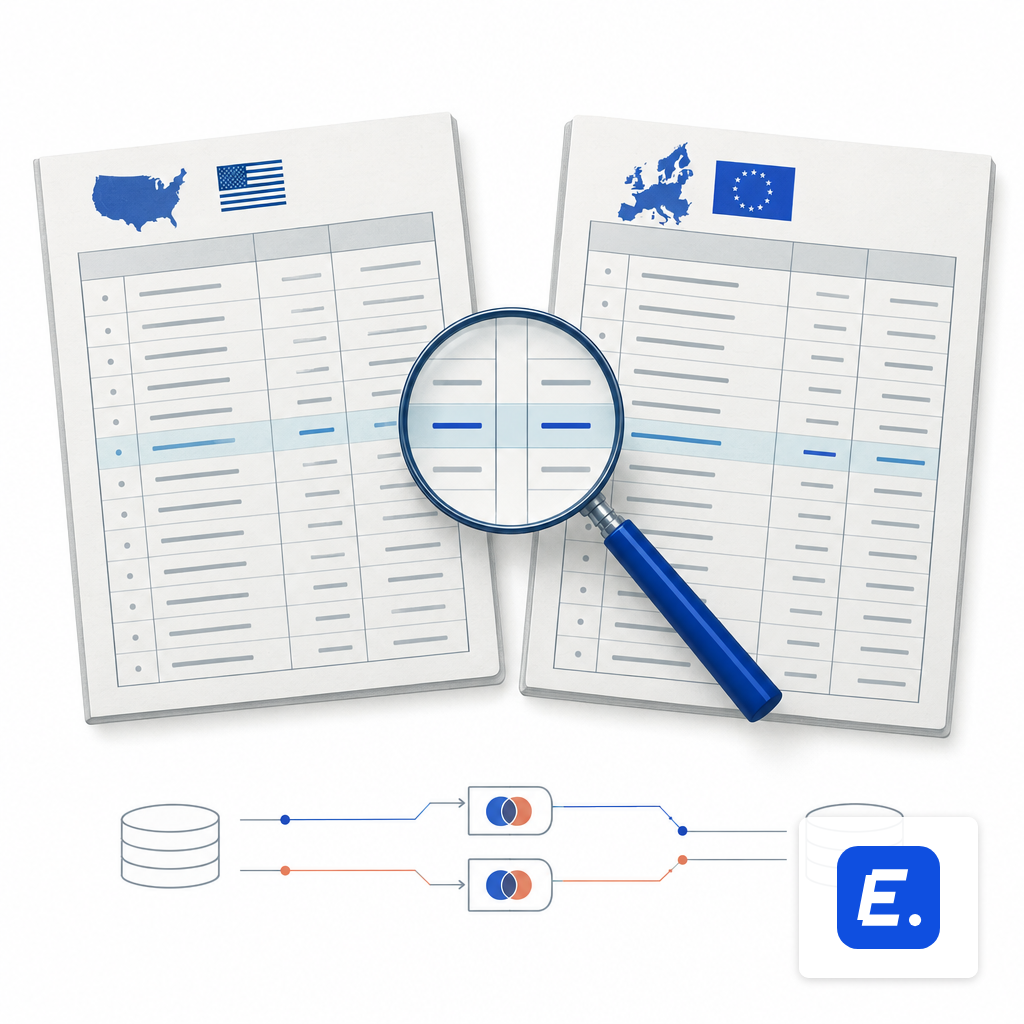
Elimination begins as a reconciliation, not a journal entry. For each intercompany pair — sales/COGS, loans, management fees, cash pooling — there is a transaction on each side. The agent's job is to pair them before anything is eliminated. The workflow has four steps and should be visible to the controller at each one:
- Extract every candidate intercompany transaction from both ledgers for the period, including unposted items flagged intercompany.
- Code each side to a counterparty entity, a currency, and an intercompany GL account consistent with the group chart of accounts.
- Check matches at the transaction level, not the account level: same amount in functional currency, same booking rate window, same counterparty.
- Post the elimination only when the match is clean; break-exceptions sit in a queue with the two underlying entries attached.
Account-level netting hides the problem. A $1.2M sub-ledger match plus a $200k mismatch in the same account produces a $1.0M net that looks reasonable and is wrong. This is the discipline mapped out in our view of multi-entity close design: match at the transaction, book at the group.
FX Revaluation Under ASC 830, Step by Step
Revaluation is where the rate discipline shows. Under ASC 830 and its IFRS counterpart, each foreign subsidiary has a functional currency, usually its local operating currency. Monetary assets and liabilities are retranslated at the period-end closing rate; non-monetary items stay at historical rates; income statement items are translated at transaction rates, in practice the monthly average. The Deloitte roadmap on CTA is explicit that the resulting translation differences move through other comprehensive income and accumulate in equity, not through P&L, until the foreign operation is disposed.
Where teams get bitten is the choice of rate. A closing rate stamped at the end of the last business day is not the same as one stamped when the subsidiary ran its own close two hours earlier. A role-based agent should pull one rate per currency per period from a named source, write it to an immutable rate table, and refuse to retranslate against any other value. The reval itself becomes mechanical. The policy question, which rate, from which feed, locked at which moment, is the one the controller actually has to own.
Proving CTA Ties Out
CTA is where auditors look first because the entry has no customer and no vendor. It is purely the arithmetic of translating a balance sheet at closing rate against equity at historical rate. If that arithmetic cannot be rebuilt line by line, the group is one restatement away from a problem.
A defensible CTA proof traces back to three things: the opening equity balance at the opening historical rate, the current-period movements translated at the applicable rates, and the closing balances retranslated at the closing rate. The difference is CTA. Under PCAOB AS 1206, when another firm audits a subsidiary the principal auditor must still be satisfied about the consolidation mechanics, intercompany eliminations included — which in practice means the CTA walk needs to be reproducible from the underlying journals, not reconstructed from a worksheet.
The size of that walk depends on where the subsidiaries sit. A US-functional group with operations in Brazil and Argentina ran 2025 with those two currencies moving in opposite directions by more than forty points combined. The CTA line is the quiet absorber of that asymmetry, and it only ties out when the per-entity contribution is attached to the line on the face of the consolidation.
Where Role-Based Agents Sit, and the Ledger They Do Not Write
The useful frame is division of labor. A deterministic ledger holds the journals, the sub-ledgers, the rate table, and the audit log. The AI in ERP layer runs agents that extract, match, calculate and propose — never post directly. An AR Agent pulls counterparty entries and proposes an elimination pair. An AP Agent reconciles intercompany expense recharges. A Controller Agent prepares the FX revaluation journal with its rate source attached, and the CTA walk with its per-entity attribution. A CFO Agent surfaces the exceptions that did not match and the balances that did not retranslate cleanly.
The journal goes to a human approver with the evidence attached. The ledger accepts the posting only through its usual controls. This is the architecture inside the erp.io platform: agents in front of the ledger, never in it. The practical effect is that the close is not faster because somebody skipped a step; it is faster because every step is now instrumented and can be run as soon as the data lands. That is the real point of treating close speed as a reconciliation problem, not a reporting one.
The Trade-Off the Controller Is Actually Making
Running intercompany, revaluation, and CTA through role-based agents means giving up the ad hoc Excel adjustments that let a controller close a stubborn entity by moving a number. Every elimination, every reval journal, every CTA attribution has to carry its evidence; the agents will not propose a posting they cannot source, and the ledger will not accept one without an approver. That is slower for the first close after cutover and faster for every one after, because the next period starts from a trial balance that already tied out. For a cross-border group under Pillar Two, PCAOB oversight, and investor patience that does not extend to another restatement, that trade is usually the right one.