ASC 606 can run on autopilot for a usage-based SaaS contract without compromising audit integrity, but only when the agent never writes to the ledger directly. The division of labor is the whole trick: deterministic rules handle anything a controller must defend without judgment, and agents propose anything that requires one.
The five-step model is where that line gets drawn. Four steps are mostly mechanical for a standard SaaS deal; one is where agents either earn their place or disqualify themselves.
The Five Steps, Split by Determinism
Step one (identify the contract) is deterministic once the agent has extracted counterparty, term and enforceability from the executed document. The engine stores the parsed fields; a controller reviews anything the agent flags as ambiguous, such as auto-renewal language or an unsigned amendment.
Step two (identify performance obligations) is where the agent proposes and a human disposes. A usage-based SaaS contract usually resolves to one stand-ready obligation satisfied over time, with overage units treated as variable consideration tied to that same obligation. For a $120,000 annual subscription, recognition runs at roughly $10,000 per month regardless of invoicing cadence. Setup fees, migration services and committed professional-services hours each need separate judgment calls that an agent should surface, not decide.
Step three (determine the transaction price) is the only step where an agent can meaningfully change a reported number. The fixed fee is arithmetic; the variable component is estimation. More on that below.
Step four (allocate) is deterministic once an SSP table exists. Step five (recognize) is deterministic once rated usage is loaded. Both run on the engine, not the agent. That split mirrors the broader argument about orchestration and ledger access for agent-native platforms.
Rated Usage Ingest Belongs in Rules, Not Prompts
Metering events arrive from the product: API calls, compute-seconds, rows processed. Turning them into billable and recognizable units is pure arithmetic over a rate card, and it has to be reproducible on demand for an auditor. The ASC 606-10-55-18 right-to-invoice expedient lets a company recognize revenue equal to the amount it has a right to invoice, which works cleanly for flat per-unit pricing but breaks the moment a tiered rate kicks in mid-period and the per-unit rate stops corresponding to value transferred.
That boundary is a rule, not a judgment, so the deterministic engine owns it. The agent's role is to flag contracts whose pricing schedule disqualifies them from the expedient and route them to a separate waterfall.
SSP Allocation Runs on a Versioned Table, Not a Model Call
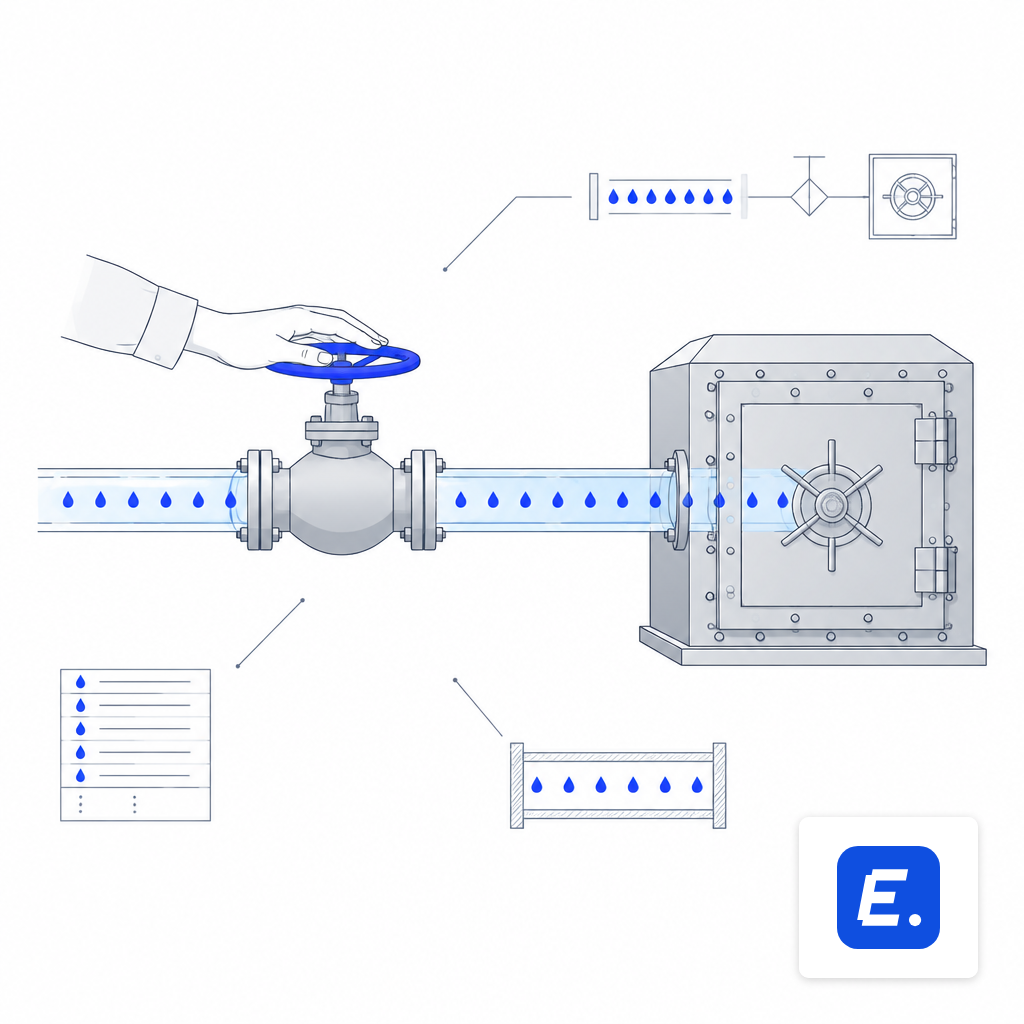
Standalone selling prices change every time pricing changes, which for usage-based products can be every quarter. The right place for SSP is a versioned reference table, not a model that regenerates the number each run. The engine reads the table at the contract's effective date, allocates transaction price across obligations using fixed ratios, and books the result.
The agent earns its keep upstream of the table. It proposes SSP updates from the latest win data and benchmark deals, explains the proposed range, and routes the change to a controller for approval before the engine starts using it. That approval is the control; the allocation math is not. SEC staff commentary has focused on this area precisely because transaction-price allocation involves significant judgment, and an agent that silently overwrites an SSP would create exactly the audit exposure that puts rev rec in the top four of comment-letter topics.
The Constraint Is a Deterministic Cap on an Agent Estimate
Variable consideration is the one place in a usage-based contract where an agent's estimate can change what hits the income statement. ASC 606-10-32-11 only admits variable consideration to the extent it is probable that no significant reversal of cumulative revenue will occur, and the estimate must be refreshed every reporting date.
The split here is strict. The agent produces an expected-value or most-likely-amount estimate for the quarter's variable fees, cites the inputs it used, and attaches a confidence band. The deterministic engine applies the constraint: it caps recognition at the probable-no-reversal threshold stored as a rule, and anything above that cap is held back until the next reassessment. The narrow sales- and usage-based royalty exception under ASC 606-10-55-65 applies only to licenses of intellectual property, so pure SaaS contracts never qualify, and an agent that invokes it on a software subscription is wrong by definition.
Contract Modifications Need a Decision Tree, Not a Judgment Call
Usage-based contracts get amended constantly: committed-use discounts, true-forwards, mid-term rate changes, overage credits. ASC 606 gives three accounting outcomes for a modification, and the determination among them is rule-based once the inputs are known. The agent parses the amendment and proposes inputs: whether added goods are distinct, whether their price reflects standalone value, and whether the remaining goods and services differ from those already transferred. The engine then applies the decision tree:
- Separate contract. Added distinct goods and services at standalone selling price. Treat forward only.
- Termination and new contract. Remaining goods are distinct from those already transferred. Reallocate unrecognized consideration prospectively.
- Cumulative catch-up. Remaining goods are not distinct. Adjust revenue at the modification date for the cumulative effect.
Routing that logic through rules rather than prompts is the point. For a deeper walk-through of where this boundary breaks down in practice, the arguments in where AI fails inside an ERP apply directly.
The Audit Trail Is What Makes Any of This Defensible
Every agent proposal produces a record the controller can replay: the prompt, the inputs, the model output, the approver, the timestamp, and the deterministic rule that converted the approved output into a posting. The ledger only ever sees the approved values. That is the mechanism that lets an agent-native platform like the erp.io platform propose rev rec entries without crossing the line into unreviewable automation.
The payoff is not just audit survival. MGI Research finds SaaS companies lose between 1% and 5% of ARR to billing leakage each year, worth $500,000 to $2.5 million for every $50 million in ARR. Most of that leakage comes from unrated usage, misapplied tiers and missed modifications, every one of which is a deterministic error caught by the same rules that gate recognition. A controller evaluating AI inside the ledger should price the recovery of that leakage alongside the close-time savings, because the two come from the same mechanism.
What Changes Over the Next Year
FASB closed its post-implementation review of Topic 606 in late 2024, which means amendments are unlikely in the near term and the ground rules will stay stable. The more consequential shift is on the SEC side: as more issuers describe AI-assisted estimates in their 10-Ks, staff comment letters will probe the controls around those estimates, not the models themselves. The firms that come through cleanly will be the ones who can point to a boundary already drawn, with the agent on one side proposing and explaining, and the deterministic engine on the other posting a number no model has touched.