Keeping a finance agent in production carries a monthly opex line the vendor quote does not cover, and underpricing it turns a six-month pilot into a surprise forecast revision.
That line covers evals, drift monitoring, version management, human review, inference and observability. The vendor quote ends at go-live; the invoice does not.
This piece prices each component so controllers can build a defensible monthly run-rate, challenge a vendor's included-support claim, and plan for the queue that AI governance now sits in. The numbers below come from published pricing pages and 2026 operator surveys, not vendor estimates.
The Six Line Items Every Agent Budget Needs
A finance agent in production is not one cost. It is six, and finance teams that budget only inference are the ones calling their FinOps lead in month four. The six are: model inference, LLM observability, evaluations, drift and output monitoring, prompt and version management, and human review of flagged items. Logging and audit retention is usually bundled into observability but is a distinct compliance obligation. Each has its own vendor, pricing model and rate of growth as agent volume scales. The pattern that catches teams out is that inference, the component vendors talk about, is usually the smallest of the six.
The FinOps Foundation's 2026 survey of 1,192 practitioners found 72% of organizations had received surprise AI bills in the past year, and 79% needed a full day or longer to trace a single cost spike. That is not a pricing problem; it is a line-item problem. The six headings below are where the money actually goes.
Model Inference Is the Cheapest Thing You Pay For
For a mid-market AP agent processing roughly 10,000 invoices a month, raw inference against a frontier model runs in the low hundreds of dollars once extraction, coding, duplicate checks and PO matching are costed at current per-token rates. That stays true even with RAG retrieval over policy and vendor master data. Inference scales linearly, caches well, and gets cheaper on a roughly nine-month cadence as model families turn over.
What makes inference look expensive is architecture, not unit price. An agent that re-plans on every turn, re-reads its tool catalog each call, or passes raw PDFs through a vision model when text extraction would do can multiply its own token bill by ten. McKinsey's work on agentic system cost notes that unoptimized planning loops and redundant tool calls are the dominant driver of per-task cost, not the model choice. Budget inference at 15 to 25% of monthly agent opex; if your vendor quote says otherwise, ask what the other three quarters are.
Evaluations Are a Recurring Cost, Not a Build
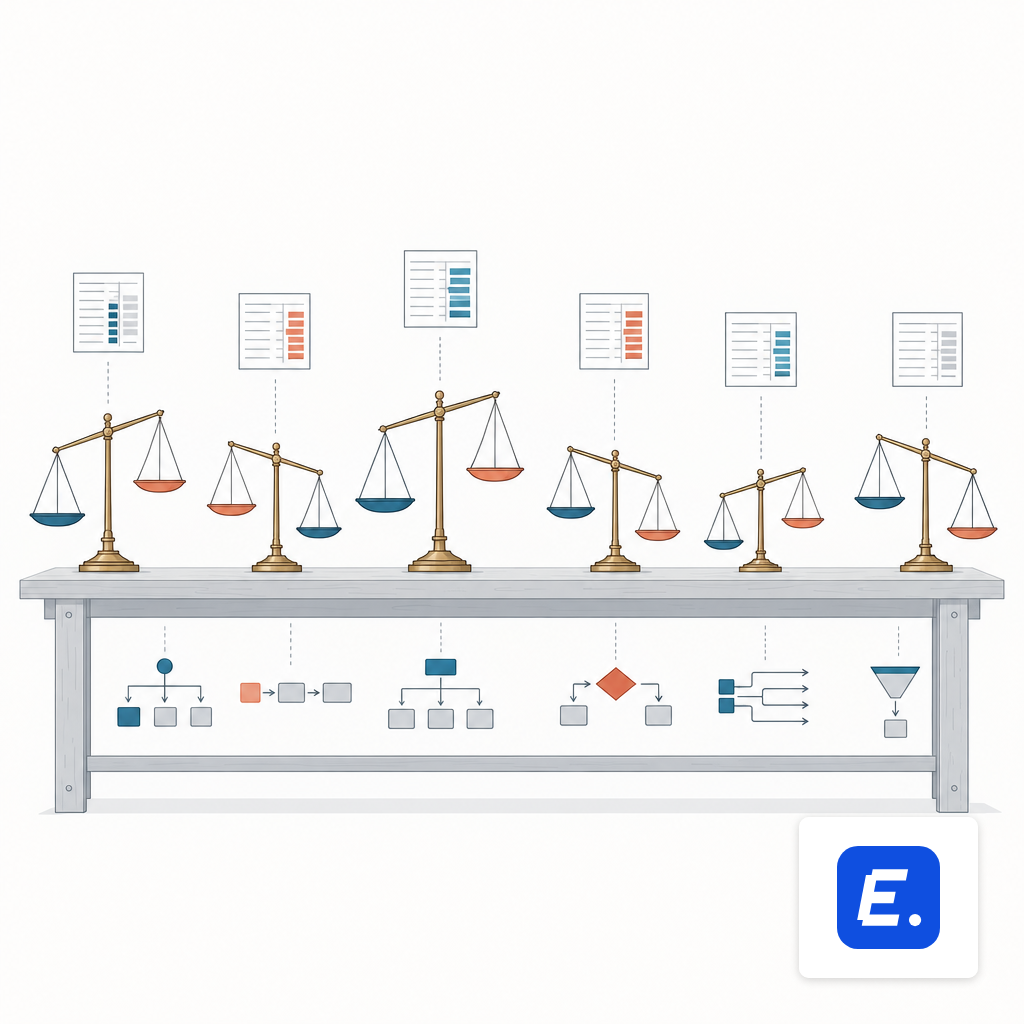
Finance agent evaluations are the test harness that answers "did this release still code expenses correctly, flag the right duplicates, and refuse the invoices it should refuse?" They have to run on every prompt change, every model version bump, and on a nightly regression schedule against a labeled dataset the finance team owns. A reasonable mid-market harness covers 300 to 800 labeled cases per agent, grows monthly, and is scored by a mix of deterministic checks and LLM-as-judge.
The opex here has three parts: the platform (Braintrust Pro at $249/month, Langfuse Pro at $199/month, or Fiddler's per-trace Developer tier), the inference cost of running the eval set itself, and finance staff time to label new edge cases as they appear in the review queue. The ServiceNow Enterprise AI Maturity Index 2026 found that although 59% of organizations now use agentic AI, only 20% have established testing, auditing or risk processes. Those missing testing, auditing and risk processes are the eval line item showing up late.
Observability Pricing Scales With Agent Volume
LLM observability tools record every span an agent emits: the tool call, the retrieval, the model response, the latency, the user or system that triggered it. Vendors price on span or trace volume, and a single invoice touched by an AP agent typically generates 15 to 40 spans across extraction, enrichment, matching and posting checks. Ten thousand invoices becomes 150,000 to 400,000 spans a month, which puts most mid-market agents above every vendor's free tier and squarely inside a paid plan.
Datadog's guidance on agent observability frames the minimum coverage as traces, evals, cost attribution and output quality — four streams, not one. Pricing a single vendor without reading what their Pro tier actually includes is how finance teams end up double-paying when evals move to a second platform.
Human Review Is a Staffing Line, Not a Technology Line
Every production finance agent routes a share of its output to a human. For an AP agent, the review queue is usually 3 to 12% of invoices: anything above an approval threshold, anything the duplicate check flagged with uncertainty, anything where coding confidence sits below the configured floor. The rate falls with eval tuning but never to zero, and the queue is what the auditor asks to see.
Staffing this queue is the biggest single line on most monthly agent budgets. A half-FTE AP clerk reviewing 400 to 800 flagged items a month, with SLA, is $3,000 to $5,000 in fully loaded cost — more than inference, observability and evals combined at mid-market volume. How the threshold is set determines the queue size; erp.io's piece on approval thresholds for an AP agent works through the SOX-compatible mechanics. Budget the queue first, then work backwards into what eval investment pulls it down.
Drift, Version Management and Logs Are Compliance Line Items
Drift monitoring catches the slow degradation that eval harnesses miss: vendors changing invoice formats, a new entity's chart of accounts bleeding into the training distribution, a model provider silently rolling a minor version. Version management keeps every prompt, tool definition and eval score tied to a release, so a regression can be traced to the change that caused it. Both sit inside observability platforms on paper and inside the controller's close checklist in practice.
The compliance tail is the one most quotes ignore. The EU AI Act's Article 12 requires high-risk AI systems to produce automatic event logs across their lifetime, with deployers retaining them for at least six months and penalties up to €15 million or 3% of global turnover for non-compliance. Six months of agent-level logs at mid-market volume is a storage and query line that scales with span volume, not with headcount. Fiddler's write-up of the NIST AI Risk Management Framework covers the same evidence trail from the US side: production monitoring artifacts are what a regulator or auditor actually reads.
A Realistic Monthly Run-Rate for a Mid-Market AP Agent
Pulling the six lines together for an AP agent processing roughly 10,000 invoices a month: inference lands at $300 to $700; observability (Pro tier of a single vendor) at $160 to $250; evaluation platform plus eval inference at $300 to $500; drift and logging infrastructure incremental to observability at $100 to $300; prompt and version management typically bundled but with roughly $150 to $250 of engineering time per month; and human review at $3,000 to $5,000. Total run-rate is $4,000 to $7,000 per month before incident response, which the PagerDuty 2026 State of AI-First Operations Report found 68% of organizations now value at more than $300,000 per hour of outage.
That number is the one that belongs on the business case alongside the implementation fee, and it is the one that erp.io's write-up on where AI fails inside an ERP argues most vendor quotes obscure. The erp.io platform bundles evals, observability and human review under the same deterministic ledger, which is a different cost structure than stitching four vendors together, but the line items are still the ones to price before signing. For teams evaluating whether that bundling actually changes the math, erp.io's free assessment works through the same six lines against a current environment.
Vendor Terms That Decide the Opex Line
Ask the vendor to itemize the monthly post-go-live cost across those six headings at the agent volume you forecast for month six and month eighteen, with named tooling, span or trace counts, and retention windows. A good answer is specific: Braintrust Pro for evals, Datadog Pro for observability with 100,000 spans and 15-day retention, a defined overage rate, six-month log retention to meet Article 12, a review-queue size tied to a configurable confidence threshold, and an incident response tier with a stated response time. A bad answer bundles everything into "included support" and sends the finance team a bill shaped by whatever happened in the quarter.