"Can five QuickBooks Online files be closed as a consolidated group without migrating the whole company to NetSuite?" The short answer is yes, provided the consolidation runs in a separate layer that reads from QBO rather than inside the entity ledgers themselves, and provided a handful of controls sit alongside that layer that QuickBooks has never been built to provide on its own. QuickBooks still carries roughly 62% of the small-business accounting market, so the group that has outgrown one file but not QBO as an accounting system is the rule rather than the exception. What follows walks through the mechanism: common chart of accounts mapping, intercompany matching, currency translation, elimination entries, and shadow-ledger reconciliation. It also names the point at which the ledger does have to move.
When a Consolidation Layer Is the Right Answer
A consolidation layer is the right call when each legal entity is independently auditable in QuickBooks but the group-level statements are not. The test is practical. If every QBO file ties to its own trial balance, each entity has a working audit trail, and the pain sits in rolling them up (eliminating intercompany, translating currencies, producing a group income statement a Big Four auditor will accept), then what's missing is a reporting layer, not a ledger. APQC's benchmark of more than 2,300 organizations puts the median monthly close at 6.4 calendar days, top performers at 4.8, and the bottom quartile at 10 or more. Multi-entity groups relying on spreadsheet consolidation often sit in that bottom quartile.
Running consolidation in Excel reads as cheap until the error rate surfaces. Panko's foundational research found that 51% of laboratory spreadsheets built from word problems contained errors, with cell error rates of roughly 3.9 to 5.2%. A workbook carrying hundreds of eliminating entries, FX rates, and manual mappings is the environment that produces those errors. A separate layer that reads source files, applies deterministic rules, and leaves the entity ledgers untouched is the alternative worth building. Our earlier piece on designing the multi-entity close covers the sequencing.
Standardize the Chart of Accounts First
The first job is a common chart of accounts the consolidation layer can map every entity into. Entity COAs drift in predictable ways. One company has three travel accounts, another has one, the newest acquisition has sub-accounts no one documented. The mapping does not require rewriting each QBO file. It requires a canonical group COA, usually four to six digits with a defined meaning per segment, plus a crosswalk from each entity's accounts into group codes. The crosswalk is version-controlled and reviewed every time an entity adds an account.
Two rules keep the mapping honest. First, no entity account maps to more than one group account; splits happen at the group level with a documented reason. Second, new entity accounts default to an "unmapped" bucket that blocks consolidation until a controller approves the mapping. Without the block, drift resumes within a quarter. This is the same discipline that makes a chart of accounts migration hold, applied continuously rather than once.
Intercompany Matching and Elimination Entries
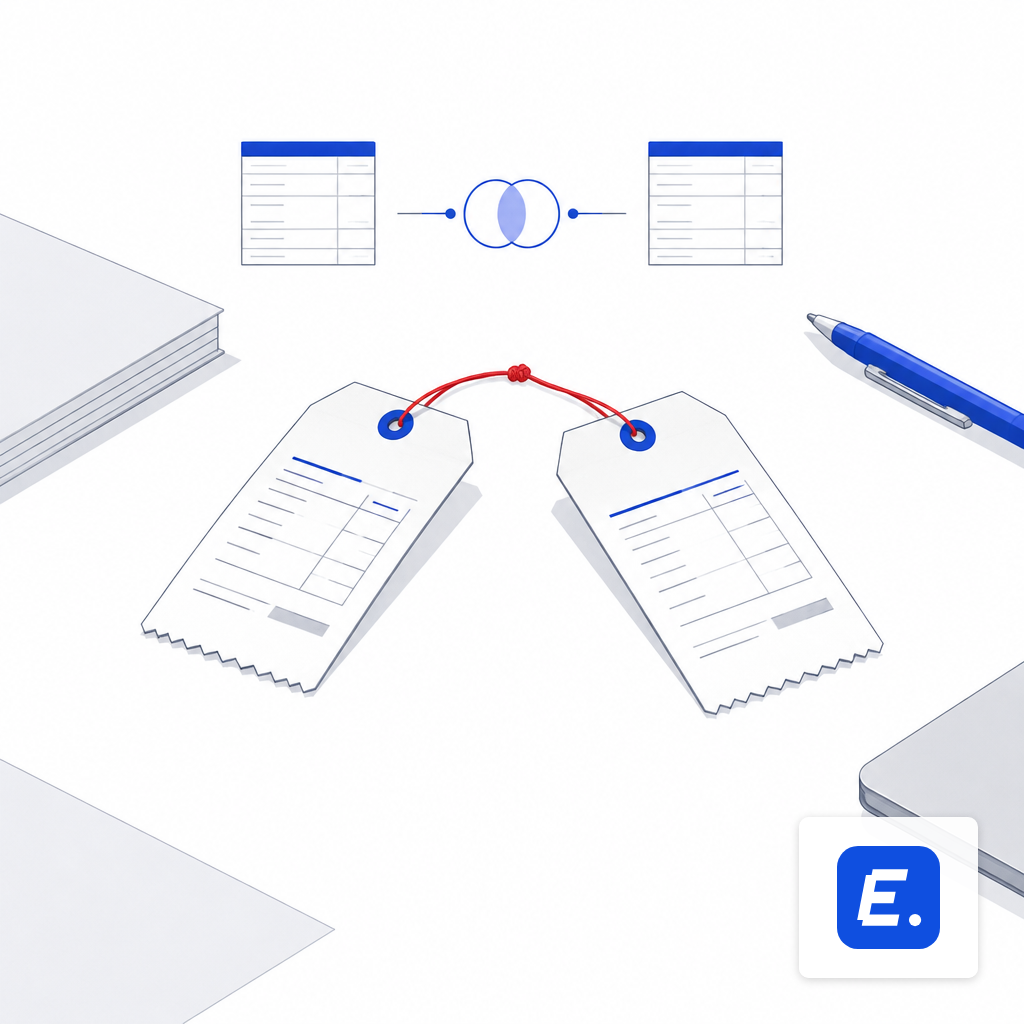
Intercompany matching is where most spreadsheet consolidations fail. The mechanism has four parts: tag intercompany transactions at entry in each QBO file (usually with a class or custom field naming the counterparty), pull them into the consolidation layer, match by counterparty and reference, and raise a mismatch when either side is missing or the amounts disagree. The match rate is a metric worth watching every close; a rate that slips signals the mapping or the tagging needs work.
Elimination entries themselves fall into predictable categories. Intercompany sales and matching cost of goods are backed out of consolidated revenue and expense. Intercompany loans and their interest income and expense net against each other. Dividends to the parent reverse against investment income. Unrealized profit sitting in inventory that moved internally but has not yet sold to a third party is removed from both inventory and equity. Each entry is a journal in the consolidation layer, never in the entity ledger, with an audit trail that names the source transactions on both sides.
Currency Translation and the CTA
Foreign subsidiaries require translation before they can be added to group statements. The standard is clear. Under US GAAP (ASC 830 / FASB Statement 52) and IFRS (IAS 21), foreign subsidiary assets and liabilities are translated at the closing rate, with the resulting exchange differences booked as a cumulative translation adjustment in other comprehensive income rather than net income. Income statements translate at an average rate for the period, equity accounts at historical rates, and the plug that balances the trial balance after translation is the CTA.
The consolidation layer needs rate tables for each reporting period, a documented rate source (central bank daily rates are the usual choice), and a reconciliation that shows the CTA ties from prior period to current. Auditors will trace it. Translating inside a workbook of linked tabs is where many groups lose the audit trail entirely.
The Shadow Ledger That Proves the Close
The most important component of a QBO-in-place consolidation is the shadow ledger, a parallel, read-only general ledger in the consolidation layer that holds every entity's trial balance, every mapped journal, every elimination, and the resulting consolidated numbers. It is the reconciliation proof the group statements depend on. Each night, the layer pulls from QBO, re-applies mappings and eliminations, and emits a reconciliation that ties group totals back to the sum of entity totals less the documented adjustments. When a number moves, the diff shows which source transaction caused it.
QuickBooks Online Advanced offers a Spreadsheet Sync feature that lets admins group companies and run consolidated reports in Excel or Google Sheets, but access is restricted to Advanced admin and standard all-access users, and the consolidation still happens inside the spreadsheet rather than in QuickBooks itself. It is useful for ad hoc reporting. It is not a shadow ledger, because nothing is written back, nothing is versioned, and nothing reconciles two sources of truth. For a sharper comparison of what sits above QBO versus a full ERP replacement, see our piece on NetSuite's keep-versus-replace cost.
- 1Open Reports menu and select Combine Reports from Multiple Companies
- 2Add Files, locate each other company file, select Open
- 3Under Select reports for combining, pick the reports to combine
- 4Choose the From and To date range and the report basis
- 5Select Combine Reports in Excel — the merged workbook opens
When QuickBooks Really Does Have to Go
A consolidation layer buys time, not forever. The signals that QBO itself is the constraint are specific: entity-level transaction volumes that push QBO's list and report performance limits, revenue recognition complexity (multi-element ASC 606 contracts with modifications) that no amount of post-close adjustment can clean up, inventory accounting that needs standard costs and variances QBO does not support, or a subsidiary acquired on a fundamentally different ledger model. The right path at that point is usually migration of the one entity that has outgrown QBO, not the whole group at once. Our write-up on integrating an agentic ERP with QuickBooks covers how the two coexist during that transition.
Where to Start
For a group with three or four QBO entities, a working consolidation layer, and pain concentrated in the close: build the common COA and intercompany tagging first, then the elimination rules, then the shadow ledger reconciliation. The close shortens inside one cycle, and the audit trail improves immediately.
For a group with FX exposure, a growing number of entities, or recent acquisition activity: install the CTA mechanism and the shadow ledger before adding any more files. Translation errors compound faster than intercompany errors because they touch equity, and the restatement risk is concentrated there.
For a group where one entity has already outgrown QBO on ASC 606, standard-cost inventory, or raw transaction volume: migrate that entity and leave the rest where they are. A consolidation layer holds the group statements together while the larger decision is made, instead of forcing an all-at-once move the calendar cannot absorb.